

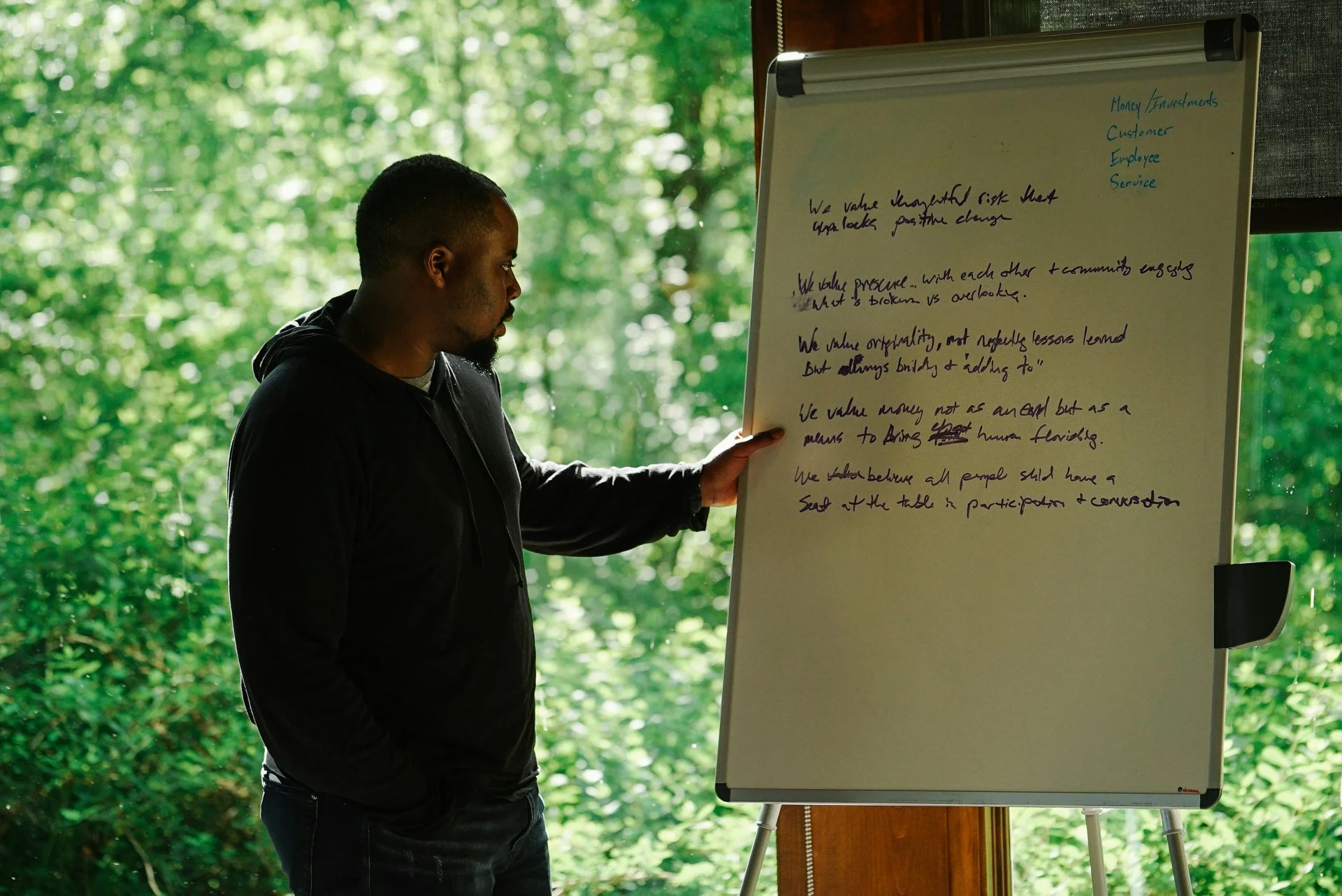
Markets move quickly.
Over the past several years, investors have navigated one of the most volatile stretches in recent memory: inflation at multi-decade highs, interest rates rising at the fastest pace in forty years, regional banking instability, and rapid technological disruption driven by artificial intelligence. According to the IMF’s most recent World Economic Outlook, global growth is moderating even as borrowing costs remain elevated — a “higher-for-longer” environment that continues to reshape capital allocation decisions.
In moments like this, portfolios become defensive.
Capital moves toward perceived safety. Liquidity becomes more valuable than innovation. Risk tolerance narrows. Emerging managers and early-stage ecosystems often feel the pullback first.
But volatility does not eliminate opportunity. It reveals how portfolios are structured — and what they are structured to protect.
At Access Ventures, we believe portfolios should not merely endure market cycles. They should be consciously constructed to support human flourishing.
Portfolios Reflect Values
Every portfolio reflects a set of assumptions.
What is worth funding.
What qualifies as risk.
What counts as return.
What is considered peripheral.
Traditional portfolio construction optimizes for financial performance within volatility constraints. That discipline matters. But if capital shapes systems — and systems shape people’s ability to flourish — then portfolio construction carries civic consequence.
Human flourishing requires:
Access & Agency
Opportunity & Autonomy
Security & Freedom
If portfolios consistently reinforce geographic concentration, capital consolidation, and short-term extraction, they may generate returns while weakening the broader foundations required for flourishing.
Recent reporting from McKinsey’s Global Private Markets Review shows that venture capital deployment has slowed and become increasingly concentrated, with a significant share of funding flowing into a narrow set of sectors — particularly AI — and established hubs. Concentration is not inherently problematic. But when capital repeatedly aggregates around familiar networks and technologies, ecosystem dynamism narrows.
Conscious construction asks a deeper question:
How does this portfolio contribute to long-term shared vitality?
Credit Tightening and the Access Gap
When macro conditions tighten, access gaps widen.
The Federal Reserve’s most recent Small Business Credit Survey shows that small firms continue to report elevated borrowing costs and stricter underwriting standards. Approval rates for financing remain below pre-pandemic levels for many entrepreneurs, particularly those without extensive collateral or long-standing banking relationships.
At the same time, regional and community banks — historically critical lenders to small businesses — have reduced lending exposure following regulatory pressure and balance sheet strain.
Small businesses represent 99% of U.S. firms and employ nearly half of the American workforce. When credit contracts in this segment, the impact is not abstract. It affects employment, neighborhood vitality, and generational mobility.
Static portfolios preserve capital in moments like this.
Dynamic portfolios recognize that catalytic capital is often most necessary when traditional liquidity pulls back.
Philanthropy in a Constrained Environment
Capital contraction is not limited to private markets.
The Giving USA 2024 report noted that charitable giving declined in real (inflation-adjusted) terms for the second consecutive year. While total giving remains substantial, purchasing power has softened, and philanthropic institutions are navigating tighter conditions.
For endowments and foundations, this moment raises an important question:
Is capital simply preserved — or is it aligned?
Increasingly, institutional investors are revisiting how their endowments reflect mission. Reporting across the philanthropic sector shows growing interest in aligning investment strategy with long-term purpose, rather than treating investment and grantmaking as disconnected silos.
A one-pocket approach reflects this shift. It recognizes that extracting maximum short-term gain from the same communities you seek to strengthen is misaligned with durable flourishing.

Diversification Beyond Asset Classes
Diversification is typically discussed across asset categories — equities, fixed income, private equity, real assets.
But flourishing-oriented diversification asks additional questions:
Are we diversified geographically, or overexposed to a handful of capital hubs?
Are we diversified across ownership pathways, including small and mid-sized enterprises?
Are we diversified across capital structures — incorporating revenue-based financing, character-based lending, or first-loss catalytic capital?
Are we diversified across time horizons, balancing liquidity with patience?
In an environment where AI investment dominates headlines and mega-cap firms capture disproportionate flows, diversification must extend beyond sectors. It must include ecosystem design.
Dynamic portfolios circulate capital across communities, not just asset classes.
Catalytic Capital in a Volatile Era
Periods of tightening are not anomalies — they are features of economic cycles.
Resilient systems are built when capital is deployed intentionally during contraction, not only during expansion.
Catalytic capital absorbs risk others cannot. It bridges financing gaps. It provides flexible structures that allow promising enterprises to stabilize and grow. It expands access when conventional markets narrow.
At Access Ventures, we approach this through a one-pocket mindset — integrating financial return and social impact within a consciously constructed strategy aligned with human flourishing.
The goal is not to abandon rigor. It is to expand perspective.
A flourishing economy requires dynamic portfolios — portfolios that preserve capital while also expanding opportunity, strengthening community resilience, and reinforcing shared dignity.
Flourishing Requires Intention
Markets will fluctuate. Innovation cycles will accelerate and cool. Credit will expand and contract.
The question is whether capital stewards remain reactive participants in these cycles — or intentional architects shaping them.
A flourishing economy is equitable.
It is dynamic.
It is resilient.
But it does not build itself.
It is consciously constructed through how portfolios are designed, how risk is understood, and how capital circulates.
When investment strategy aligns with human dignity and long-term vitality, capital does more than generate return.
It cultivates flourishing.
(Originally posted February 2021, updated March 2026)
Keep Exploring
Community flourishes when capital, people, and institutions move together.
Explore more on this topic — recommended episodes, posts, portfolio companies, and resources below:
More Than Profit podcast episodes


other blog posts


resources for download



We're proud to welcome Dr. Amy Orr-Ewing, one of the most respected apologists in the English-speaking world as a Senior Fellow at Access Ventures. In her essay, she argues that the renaissance of belief now stirring in boardrooms, parliaments, and centers of tech innovation is inseparable from the work of human flourishing we care about.